
Fashion Brands Are Not Ready — and the Clock Is Running
The EU Digital Product Passport (DPP) is not a labeling update. It is not a sustainability report rebranded into a QR code. It is a machine-readable, legally enforceable data architecture that will require fashion brands to document their products at a level of technical precision that most have never attempted. And it sits under one of the most comprehensive pieces of product regulation the EU has ever enacted: the Eco design for Sustainable Products Regulation (ESPR).
The brands quietly panicking are not the ones ignoring the DPP. They are the ones who have started reading the regulation.
July 2027 is not far away. Yet across boardrooms in Milan, Paris, London, and New York, compliance officers and supply chain managers are staring at the same uncomfortable reality: they do not have the data that the EU’s Digital Product Passport requires — and many do not fully understand what that data actually needs to contain.
Once you understand that the DPP requires traceable fiber composition data above the 1% weight threshold, full REACH chemical compliance records, and Life Cycle Assessment (LCA) documentation — for every SKU, every season — the scale of the operational challenge becomes clear. Fast fashion brands running 5,000+ new styles annually face a data collection problem that cannot be solved with a spreadsheet or a sustainability pledge.
This guide addresses the engineering reality of DPP compliance: what the data requirements actually mean at a technical level, where the friction points are for blended fabrics and complex supply chains, and how brands can begin building the infrastructure they need before enforcement begins.

What the EU ESPR Regulation Actually Mandates
The Digital Product Passport is defined under Regulation (EU) 2024/1781, the Eco design for Sustainable Products Regulation (ESPR), which replaces the previous Eco design Directive and dramatically expands its scope from energy products to include textiles, footwear, furniture, and electronics.
Under ESPR, the DPP functions as a product-specific data carrier. For textile products, this means:
- A unique product identifier linked to a QR code physically present on the product label
- A digital record accessible via that QR code, hosted on an EU-compliant data registry
- That record must contain material composition, chemical substance data, durability metrics, repair ability information, recycled content percentages, and end-of-life instructions
Enforcement for textiles begins July 2027, applying first to large enterprises before phasing to SMEs. The European Commission’s implementing regulations for textiles are expected to be finalized in late 2026, but the core data categories are already established in the ESPR framework.
The QR code requirement is not cosmetic. It must be machine-readable, durable for the product’s full lifecycle, and link to a data set that is updated when product information changes. A static product page is not compliant. The data infrastructure must support dynamic updates — meaning brands need both the data and the systems to manage it.

The Engineering Challenges No One Is Talking About
Most DPP guides published by consultancies and trade associations’ focus on the business transformation layer: supplier onboarding, software platforms, data governance frameworks. These are real challenges. But beneath them sits a more fundamental problem that requires textile engineering expertise to solve: the data itself is technically complex to generate, verify, and maintain.
1. Fiber Composition Tracking Above the 1% Weight Threshold
EU textile labeling has always required fiber content disclosure, but the DPP raises the bar substantially. Under ESPR implementing regulations, brands must document all fiber components present at or above 1% of total fabric weight — not just the primary fiber blend.
For a basic 80% cotton / 20% polyester jersey, this is straightforward. For the fabrics that actually populate commercial fashion ranges, it is not.
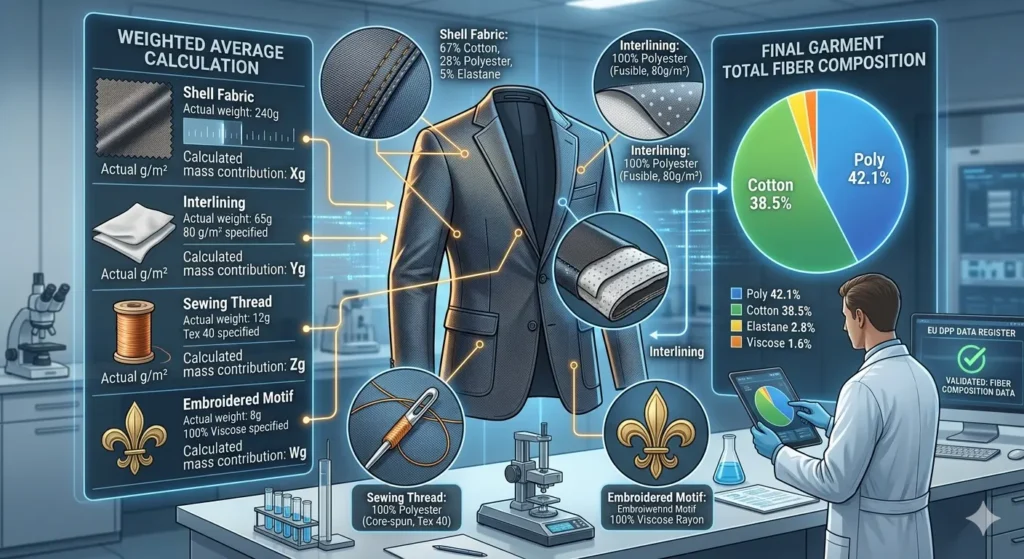
Consider a stretch woven fabric with the following construction:
- Shell: 67% cotton, 28% polyester, 5% elastane
- Interlining: 100% polyester (fusible, 80 g/m²)
- Sewing thread: 100% polyester (core-spun, tex 40)
- Embroidered motif: 100% viscose rayon
Each of these components contributes to the garment’s total fiber mass. The DPP does not ask for the shell fabric composition — it asks for the finished garment composition. This requires brands to conduct or obtain component-level weight analysis and calculate weighted average fiber percentages across the entire assembled product.
Thread weight is routinely ignored in current labeling practice because it falls below the 2% threshold required for EU textile labeling under Regulation (EU) No 1007/2011. But as interlining weights increase or embellishments are added, component contributions can exceed the 1% DPP threshold — triggering disclosure obligations that brands may not have anticipated.
The engineering solution requires Bill of Materials (BOM) data with quantified weights per component, not just fabric descriptions. For brands currently receiving BOMs from suppliers in qualitative terms (“light interlining,” “standard thread”), the data collection process must be rebuilt from the component specification level upward.
2. REACH Chemical Data for Blended and Finished Fabrics
The EU’s REACH Regulation (Registration, Evaluation, Authorisation and Restriction of Chemicals) requires disclosure of Substances of Very High Concern (SVHCs) present above 0.1% by weight in articles. The DPP integrates REACH compliance into its data structure — meaning brands must hold documented SVHC status for every substance present in their finished garments.
For a plain cotton poplin, REACH compliance documentation is relatively manageable. For a performance synthetic with a durable water repellent (DWR) finish, an antimicrobial treatment, a flame-retardant coating, and a softening agent applied at the dye house, the chemical complexity multiplies rapidly.
The challenge for brands is threefold:
First, most brands do not know what chemicals are present in their finished fabrics at the concentration level REACH requires. They hold dye house process sheets that list chemicals used, but not residual concentrations in the finished substrate. REACH compliance under DPP requires actual substance presence data — not just process inputs.
Second, SVHC list management is dynamic. The European Chemicals Agency (ECHA) updates the Candidate List of SVHCs periodically. A substance not on the list when a product is developed may be added before it reaches market — or during its commercial lifecycle. DPP data records must be updateable to reflect these changes, requiring brands to maintain ongoing chemical surveillance rather than treating REACH as a one-time certification.
Third, blended fabrics present compounding complexity. A polyester-cotton blend with a reactive dye print, a polyurethane coating, and a biocidal finish may involve dozens of individual chemical substances. Obtaining credible third-party chemical testing data — via methods such as ICP-MS for heavy metals, GC-MS for organic compounds, and LC-MS/MS for per- and poly fluoroalkyl substances (PFAS) — is a cost and time commitment that requires systematic planning, not ad-hoc testing.
3. Life Cycle Assessment for Blended Fabrics
The DPP requires LCA data to enable the calculation of environmental footprint metrics across a product’s lifecycle. For the textile industry, the methodological and data challenges of LCA are substantial — and largely underappreciated outside engineering and sustainability science circles.
The EU Product Environmental Footprint (PEF) methodology, which forms the basis for DPP environmental scoring, uses 18 impact categories including global warming potential, water scarcity, eutrophication, human toxicity (cancer and non-cancer), and land use. For a finished garment, these impacts must be quantified across raw material production, fiber processing, yarn manufacturing, fabric production, dyeing and finishing, garment assembly, transport, consumer use phase (including washing and drying), and end-of-life.
For a single-fiber product — pure organic cotton or 100% recycled polyester — primary LCA data and published eco invent database entries provide a workable foundation. For blended fabrics, the complications are significant:
Allocation at the fiber level: When a polyester-wool blend is processed in the same dye house as 100% wool fabrics, how are the environmental impacts of shared dye house operations allocated across fiber types? The PEF methodology specifies allocation rules, but applying them requires detailed process data from suppliers who frequently do not hold it.
Recycled content verification: The DPP requires brands to distinguish between pre-consumer and post-consumer recycled fiber content. For mechanically recycled cotton blended with virgin fiber, the mass balance and fiber identity verification requires chain of custody documentation aligned with standards such as the Global Recycled Standard (GRS) or the Recycled Claim Standard (RCS).
Consumer use phase modeling: Washing frequency, temperature, detergent type, and drying method dramatically affect the lifecycle footprint of washable textiles. The PEF methodology provides default assumptions for EU household washing behavior, but product-specific claims require defensible modeling — particularly for technical garments marketed on performance or durability grounds.
Building credible LCA documentation for a product range requires either in-house LCA capability (specialist software such as SimaPro or Open LCA, plus a trained practitioner) or commissioned third-party studies. For brands with seasonal design cycles, neither is trivially achievable at scale.
Building DPP-Ready Technical Data Infrastructure
Technical Data Sheets (TDS) at garment level, not fabric level. Each garment SKU needs a structured data record covering component-level fiber composition by weight, chemical treatment history, country of origin at each production stage, and quality/test certification references. These feed the DPP data record and must be version-controlled.
Supplier data protocols that specify the format and content of information suppliers must provide — including weigh-per-unit data for components, dye house chemical process sheets, and conformity documentation for restricted substances. This cannot be retrofitted through questionnaires; it requires contractual specification in supplier agreements.
Chemical management systems that map substances to finished products, track SVHC list updates, and flag affected SKUs when candidate list changes occur. Spreadsheet-based approaches are not adequate for catalog-scale management.
LCA templates calibrated for your product categories, using consistent system boundaries and data sources, so that footprint calculations are comparable across seasons and defensible in the event of regulatory audit.
QR code and data registry integration, linking physical product labels to the DPP data record in an EU-compliant registry. The interoperability requirements for DPP registries are still being finalized at the EU level, but brands should begin evaluating platforms that are building toward the EU DPP data space architecture.
At Last
The DPP is also not exclusively a compliance burden. Brands with clean, verified technical data will be better positioned to communicate product quality to B2B buyers, meet retailer ESG supply chain requirements, and respond to growing consumer transparency expectations. The data investment has commercial value beyond the QR code on the label.
If your brand is facing a July 2027 deadline without the technical data to meet it, the most productive next step is a systematic assessment of your current data position.
Need technically accurate content for your textile or fashion brand? Let’s talk.”